Discounting to Present Value: Terminal Value, Halal Ninja's 13.77 Dollars and the Verdict Time Delivered: A Sharia Analysis for Muslim Investors (2026)
Verdict: Discounting future cash flows to a present value is permissible; the time value it relies on is the deferred-price logic the fiqh of sales has always recognised, and no loan exists inside a valuation model. The fourth post of Halal Ninja's DCF series teaches the mechanics clearly, chooses the humbler of the two terminal value models, and produced a number, $13.77 per share for Stitch Fix, that the following five years vindicated against a market that paid eight times more, though its terminal value carries a discounting slip this article corrects. Yet the series never tells the reader what the number means for a decision, never mentions the purification duty on the cash flows it discounts, and ends its arithmetic where the Muslim investor's obligations begin. This article finishes the job, and completes the Apple valuation our previous two posts built.
In January 2021, three weeks after Halal Ninja's series concluded that Stitch Fix was worth $13.77 per share, the market bid the stock to $106.41. In August 2026 it trades at $4.20. Whatever else one says about discounted cash flow, the episode is a controlled experiment: one number produced by weighing, one produced by crowding, and five years of arbitration. The weighing won. That is the strongest argument for learning the final step of the machine, and the strongest indictment of teaching it without saying what it is for.
What Halal Ninja's Final Step Does
The article, published in January 2021, discounts each projected year of free cash flow by the WACC built in the previous instalment: present value equals the year's cash flow divided by one plus the rate, raised to the year. At their 17.37 percent rate, Stitch Fix's projected years sum to a net present value of $580 million. Then the terminal block: since a business does not stop at year ten, the model capitalises its year-ten earnings into a perpetuity. Their convergence method divides year-ten net operating profit after tax of $359 million by the WACC to give a terminal value of $2.07 billion, which the article carries into the present as $307 million.
That last number contains a slip the series never caught. The article discounts the terminal value by multiplying by one minus the rate, raised to the tenth power, instead of dividing by one plus the rate raised to the tenth; the two operations agree at small rates but part company badly at 17.37 percent.
 terminal value: $2,067,161k

 their step:  x (1 - 0.1737)^10  ->  $306,726k
 correct:     / (1 + 0.1737)^10  ->  $416,681k
Discounted correctly, their terminal value is worth about $417 million today, their total rises to roughly $997 million, the terminal share becomes about 42 percent rather than a third, and the final instalment's $13.77 per share becomes roughly $15.5. The direction of their story survives, the market price was still several times the corrected number, but a tutorial exists to be reproduced, and a reader who reproduces this one correctly will not match its table.
Two further details deserve more attention than the article gives them. First, the projected leap from $12.67 million of free cash flow in year zero to $56.15 million in year one, a quadrupling that sits unremarked inside the table doing enormous work. Second, the discount rate's power: at 17.37 percent, a dirham arriving in year ten is worth 20 cents today; at 10 percent it is worth 39 cents. The rate chosen in part three, built as our discount rate analysis showed on a vanished 0.93 percent Treasury world, does more to the final answer than most of the cash flows projected in part two.
The Terminal Value Question
Terminal value is where a DCF quietly models eternity, a perpetuity of cash flows beyond the forecast horizon. The Qur'an keeps the ambition in proportion. Allah says in Surah Ar-Rahman, verse 26:
كُلُّ مَنۡ عَلَيۡهَا فَانٖ
"Everyone upon it [i.e., the earth] will perish," (Saheeh International)
No business earns forever, and most do not earn for long; competitive advantage erodes, industries turn over, and the average corporate life is measured in decades, not perpetuities. This is why the choice between terminal models matters more than beginners are told. The convergence model Halal Ninja uses assumes competition grinds excess returns to nothing, so the perpetuity capitalises bare profit with no lasting moat. The value-driver alternative assumes the moat endures forever. Between a model that assumes decay and one that assumes corporate immortality, the convergence choice is the humbler and, given the ayah above, the one this site is happier to endorse. Credit to Halal Ninja on a second count too: the article notices that its own high discount rate eviscerates the terminal value, and says so plainly, though the effect is exaggerated by the discounting slip above; done correctly the terminal block still carries about 42 percent of their total, against the half to two thirds growth-company valuations often show.
Completing the Apple Valuation
Our previous two posts ran Halal Ninja's curriculum properly on a screened company: the projection article built Apple's cash flow scenarios on its stable 26 percent free cash flow margin, and the discount rate article built a 10 percent required return with no interest instrument in the chain. The final step is this article's job. Discounting each scenario's ten years and a 3 percent perpetuity gives:
| Revenue growth for 10 years | PV of years 1 to 10 | PV of terminal value | Total value | Share in terminal block | Against $4.57T market cap |
|---|---|---|---|---|---|
| 3% a year | $774bn | $833bn | $1.61tn | 52% | 35% |
| 5% a year | $853bn | $1,009bn | $1.86tn | 54% | 41% |
| 8% a year | $989bn | $1,337bn | $2.33tn | 57% | 51% |
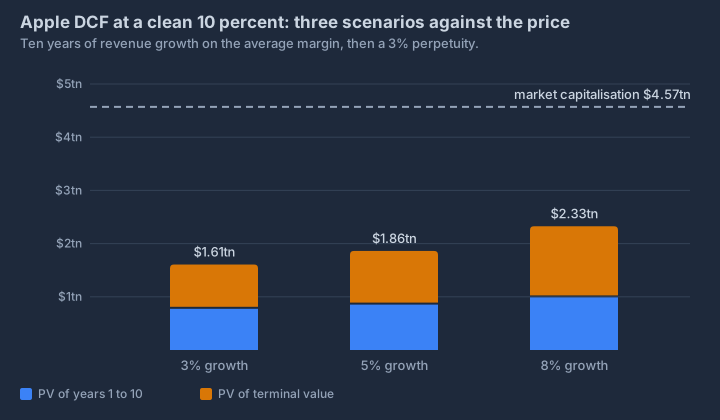
One simplification to declare, the same one our NVIDIA reverse DCF declared: we compare the value of the cash flows directly with the market capitalisation, which is conservative in the model's disfavour because Apple holds net cash. The reading is stark even so. At honest growth assumptions, the weighing machine reaches barely a third to a half of Apple's $4.57 trillion price. Inverting the question, the price embeds roughly 18.5 percent compound free cash flow growth for a decade measured from the filed fiscal 2025 figure of $98.8 billion, reaching about $538 billion; start instead from the normalised margin base the scenarios use and the implied rate is nearer 17 percent, the same claim in different clothes. Apple's actual free cash flow growth from fiscal 2021 to fiscal 2025 was 1.5 percent a year. A wonderful business, screened and compliant per our Apple analysis, whose price currently assumes a transformation its filed accounts have not begun to show. That sentence is not a sell recommendation; it is what the ayah calls an even balance, read aloud. Note also that half or more of every scenario sits in the terminal block, the number modelling forever, which is exactly where your scepticism should concentrate. Our own terminal block allows a 3 percent growing perpetuity, a modest moat assumption Apple has to keep earning; the strict convergence treatment we praised above would land every total lower still, so the choice leans in the price's favour, not ours.
The Purification Layer the Series Never Mentions
Here is the obligation that belongs precisely at this step and appears nowhere in Halal Ninja's five parts. The cash flows a Muslim discounts are not entirely theirs to keep. A screened company may still earn up to 5 percent of revenue from impermissible sources under the AAOIFI Standard 21 tolerances, and that fraction must be purified, given away, not retained. On the income-based reading of the duty, whose contested edges the Where Scholars Differ section below maps, a careful Muslim valuation acknowledges this at the point of discounting: the stream being valued is the purified stream, and for a company near the tolerance ceiling the haircut is material to the fair value itself. At minimum, the purification duty belongs in the same breath as the output number, because the model's answer is not "what the shares are worth to anyone" but "what the lawful portion is worth to you". Screening tells you the duty exists, and the stock screener reports the ratios that size it. Assets with nothing to discount sit outside this machinery entirely, which is why compliance from the crypto screener answers a different question than valuation ever can.
The Maysir Question: What $13.77 Was For
Maysir is wealth staked on chance rather than judgement, and none of the scholars cited on this site has ruled on point estimates, so this section applies the principle on its own account.
 Jan 2021   their model     $13.77  ($15.5 corrected)
 Jan 2021   market peak    $106.41
 Aug 2026   market price     $4.20
The series ends by saying that comparing the computed value to the trading price "gives you an idea" of whether to buy. It never says what its own comparison showed: the market price was several times the computed value, and the machine was screaming that price and worth had parted company. A tool that produces the most contrarian statement on your website deserves a conclusion, not a shrug. The Muslim discipline is to treat the output as a falsifiable claim and act on it: state the range, state the price at which you would buy, and refuse the trade above it. Weighing that never informs a decision is ritual, not analysis. The alternative, buying at any price because the chart is rising, is the drift toward the wager that valuation exists to prevent.
What Halal Ninja Gets Right, and What It Leaves Out
Credit first, and this instalment earns real credit. The discounting formula is stated correctly and clearly taught. The convergence terminal model is the humble choice, made deliberately, with the value-driver and exit-multiple alternatives fairly described. The article notices and names the unusual smallness of its own terminal value. And the final number was directionally vindicated by five years of subsequent history, which is more than most 2021-vintage analysis can say.
What it leaves out is the half of the job its audience came for. The series discounts unpurified cash flows on a site named for halal investing and never mentions the duty. It buries a fourfold year-one leap in a table, and its terminal value discounting multiplies where it should divide, an error no instalment catches. It presents a single point estimate off a single rate, where ranges are the honest format. It stops at "gives you an idea" rather than teaching the reader to convert value into a decision rule. And across all five parts, no standard, no scholar, no screen. Our trilogy is better by coverage, not opinion: the same machine on a screened company, purified cash flows acknowledged, scenarios instead of a point, the terminal block sized and distrusted aloud, and a decision discipline stated at the end.
Where Scholars Differ
The permissibility of discounting is settled for the reasons our DCF fiqh analysis documents; the live differences sit in purification, the layer this article adds. One position works from distributions: Mufti Taqi Usmani's Principles of Shariah Governing Islamic Investment Funds directs that the impermissible proportion of the dividend be given to charity, and then extends the cleansing to capital gains as a matter of equity, a middle position anchored in what the investor receives. A second position requires purifying the investor's share of the company's impermissible income whether or not a dividend is paid, reasoning that ownership, not receipt, creates the duty; AAOIFI Standard 21 is commonly read this way, Sheikh Joe Bradford's published purification calculations work from operational income and describe the dividend-only method as not broadly held (joebradford.substack.com), and Mufti Faraz Adam's Amanah Advisors methodology, tracing revenue streams individually, points the same way. For a valuation, the choice matters: a receipt-based purification leaves a non-payer's cash flows untouched, income purification haircuts them all. This article presents both and does not arbitrate.
Practical Guidance
Discount the scenarios you projected, not a single line, and at the rate you defended in writing. Report the terminal value's share of every total and let your confidence shrink as that share grows. Purify in the method your scholar of reference requires, and if you follow the income-based view, value the purified stream. Convert the output into a decision rule before you look at the chart: the price at which you would buy, the price at which you would not, and the assumptions that would change your mind. Then obey your own rule. The Stitch Fix episode is the whole lesson in one chart: the crowd paid $106 for a business the weighing machine priced at $13.77, and time sided with the machine.
Conclusion
The present value step is where a DCF stops being spreadsheet exercise and becomes a claim about the world. Halal Ninja taught the step clearly, chose the humble terminal model, slipped once in discounting it, and still produced a number history defended. What it never taught is what the number is for and what it obliges: a decision rule for the investor, a purification duty for the Muslim, and permanent suspicion of the perpetuity block in a world where everything upon the earth passes away. Completed properly on Apple, the machine converts a $4.57 trillion price into a falsifiable claim, 18.5 percent compound growth for a decade from a company that just delivered 1.5 percent, and hands you the only question that matters: do you believe it? Weigh, purify, decide. That is the full job, and it was always the part a halal investing site owed its readers most.
This analysis is educational and is not a fatwa, a price target, or financial advice. Figures are from the filings and sources cited and change with each reporting period; verify before acting.
Frequently Asked Questions
Is discounting future cash flows to present value halal?
Yes. Discounting is the deferred-price logic of permitted sales run in reverse, no loan exists inside a model, and no riba arises. The full fiqh treatment is in our dedicated DCF analysis.
What is terminal value and why does it dominate valuations?
It is the capitalised value of all cash flows beyond the forecast horizon, a modelled perpetuity. In our Apple scenarios it carries 52 to 57 percent of total value, which is why its assumptions deserve the hardest scrutiny of any input.
Which terminal value model should I use?
The convergence model assumes competition erodes excess returns and capitalises bare profit; the value-driver model assumes the moat lasts forever. The convergence choice is the humbler default, and it is the one Halal Ninja's article rightly uses for Stitch Fix.
Was Halal Ninja's $13.77 valuation of Stitch Fix right?
Directionally, yes, though the terminal value was discounted with the wrong operation; corrected, the model gives roughly $15.5 per share. The market paid up to $106.41 within weeks; by August 2026 the stock traded at $4.20, below either figure. The deeper failure was the silence about what the comparison implied.
What is the purification duty in a DCF?
A screened company may earn up to 5 percent of revenue impermissibly under AAOIFI tolerances, and that fraction must be given away, not kept. A careful valuation discounts the purified stream, or at minimum states the duty next to the output.
What does Apple's price imply under this model?
At a 10 percent required return and 3 percent terminal growth, roughly 17 to 18.5 percent compound free cash flow growth for ten years depending on the base year used, against filed growth of 1.5 percent a year from fiscal 2021 to 2025. The gap is the claim you are asked to believe at $4.57 trillion.
How should I act on a DCF output?
Turn it into a decision rule before consulting the chart: a buying price, a walking away price, and the assumptions that would change them. A valuation that never constrains a decision is ritual, not weighing.
Sources
- Discounting FCF and Finding Present Value - Halal Ninja (part four of the DCF series)
- Putting It All Together - Halal Ninja (final instalment, the $13.77 result)
- Qur'an 55:26, Arabic and Saheeh International translation
- Stitch Fix Stock Price History (companiesmarketcap.com)
- Stitch Fix Financials (stockanalysis.com)
- Apple Form 10-K, fiscal 2025 (SEC EDGAR)
- Apple Stock Overview, price and market capitalisation (stockanalysis.com)
- AAOIFI Shari'ah Standards (Standard No. 21, Financial Paper)
- Mufti Taqi Usmani, Principles of Shariah Governing Islamic Investment Funds
- Sheikh Joe Bradford, How We Calculate Zakat on Stocks
- Mufti Faraz Adam, Amanah Advisors
Related Articles
- Projecting Free Cash Flow Forward: Halal Ninja's Margin Method
- Finding the Discount Rate: A Cleaner Chain for Muslim Investors
- Valuing Companies with DCF: A Reverse DCF on NVIDIA
- Is DCF Valuation Halal? Discount Rates, Time Value of Money and Sharia
- Is Apple Halal? Sharia Screening for Muslim Investors