Finding the Discount Rate: The Interest Assumptions Inside Halal Ninja's WACC and a Cleaner Chain: A Sharia Analysis for Muslim Investors (2026)
Verdict: Computing a discount rate is permissible; nothing is lent, nothing is paid, and no riba arises from arithmetic. But the WACC that Halal Ninja builds in the third post of its DCF series imports three interest-shaped assumptions without a word of fiqh: a US Treasury yield as the floor beneath all value, a tax deduction for interest inside the cost of debt, and the very concept of a risk-free return, which fiqh al-mu'amalat denies can lawfully exist. None of this makes the calculation haram to perform. All of it deserved discussion on a site named Halal Ninja, and none of it received any. A Muslim investor can build the same dial with a cleaner chain, and for AAOIFI-screened companies the debt leg of the formula barely matters anyway.
A discount rate is the answer to a personal question: what annual return must this investment offer before it deserves my capital instead of my alternatives? Halal Ninja's article, published in December 2020, frames this correctly and well, calling WACC the opportunity cost for investors. The framing is right. The construction is where the unexamined interest assumptions live, and since the discount rate does more to a DCF's output than any cash flow projection, whoever sets the rate quietly sets the valuation, a lesson our reverse DCF on NVIDIA demonstrates numerically.
What Halal Ninja Builds
The article assembles a weighted average cost of capital for Stitch Fix in four steps, and the arithmetic is worth laying out because each step carries an assumption.
| Component | Their input | Their result |
|---|---|---|
| Capital weights | Debt $164.5m, equity $6,484m market cap | 2.5% debt, 97.5% equity |
| Cost of debt | Interest expense over total debt, times one minus tax | 4.73% |
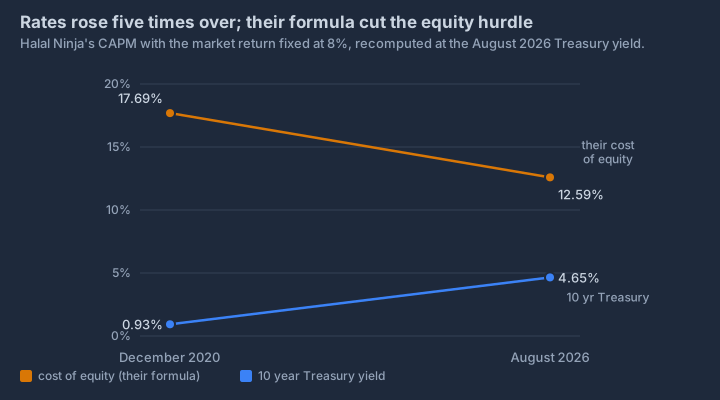
| Cost of equity (CAPM) | Risk-free 0.93%, beta 2.37, market return 8% | 17.69% |
| Overall WACC | Weighted combination | 17.37% |
Judged as conventional finance instruction the sequence is textbook. The weights are computed correctly, the capital asset pricing model is applied as every MBA course applies it, and the final blend is arithmetically sound. The fiqh questions sit inside the inputs, and a sketch of the construction shows where.
              WACC 17.37%
             /            \
     equity leg           debt leg
     97.5% weight         2.5% weight
         |                    |
  0.93% Treasury yield   leases labelled
  + 2.37 x (8% - Rf)     as debt, x (1 - tax)
         ^                    ^
         |                    |
   riba as the floor    riba's tax subsidy
The Riba Question: There Is No Risk-Free Return
The CAPM's foundation stone is the risk-free rate, here the ten year US Treasury yield of 0.93 percent. Two separate issues arise, and the article addresses neither.
The first is what the number is. A Treasury yield is interest on a loan to a government, the textbook case of riba. Referencing it in a private calculation creates no riba, since nothing is lent and nothing is paid; Mufti Taqi Usmani's position on conventional pricing benchmarks in An Introduction to Islamic Finance (1998) tolerates using an interest rate as a reference while calling the dependence undesirable, and our DCF fiqh analysis sets out why a spreadsheet cannot commit riba. Permissibility is not the gap. The gap is that a site teaching Muslims valuation reached for a bond yield as its baseline without telling readers a question exists, or that nothing obliges the choice.
The second issue is the concept itself. Islamic commercial law is built on the maxim al-kharaj bi al-daman, yield accompanies liability, derived from a hadith recorded by Ahmad, Abu Dawud, at-Tirmidhi, an-Nasa'i and Ibn Majah: entitlement to return follows from bearing the risk of loss. A guaranteed increment on money lent, return with no exposure to loss on the principal, is not a lawful baseline in fiqh; it is precisely the thing prohibited, and the companion maxim al-ghunm bi al-ghurm, gain accompanies the risk of loss, states the same rule from the other side. Conventional finance treats the risk-free rate as the natural floor beneath all value. Fiqh treats it as a category error. A Muslim analyst who anchors required returns to risk-bearing alternatives, equity returns, sukuk profit rates, rental yields, is not applying a workaround; they are working from the correct first principle. Allah says in Surah Al-Baqarah, verse 275:
وَأَحَلَّ ٱللَّهُ ٱلۡبَيۡعَ وَحَرَّمَ ٱلرِّبَوٰاْ
"But Allah has permitted trade and has forbidden interest." (Saheeh International)
The verse permits profit from trade, which bears risk, and forbids the increment on lending, which does not. A discount rate built entirely from the first category is not merely clean; it is more coherent than the conventional construction.
The Tax Shield Problem
Halal Ninja's cost of debt multiplies by one minus the tax rate, and the article correctly explains why: interest is tax-deductible, so the state refunds part of every interest payment. That deduction is a subsidy attached to riba financing. Importing it into your discount rate means your estimate of fair value now depends on a government's decision to make borrowing cheaper than it really is. No scholar in scope has published a position on tax shields inside discount rates, so this is our own application rather than a quoted ruling, but the logic is straightforward: an analyst who prefers not to build on riba has no reason to build on riba's tax treatment either.
There is also a labelling problem the article inherits without noticing. Stitch Fix's entire $164.5 million of "debt" was operating lease liabilities, rent obligations for premises, capitalised onto the balance sheet by accounting rules. The company had no interest-bearing borrowings at all, which is part of why it screens well on the ratios. Dividing "interest expense" by lease liabilities and calling the result a cost of debt treats rent as riba financing. For a Muslim analyst the distinction is not pedantry; whether a company's obligations are loans or leases is exactly what the AAOIFI screens exist to distinguish, as our AAOIFI guide explains.
The Vintage Problem, and a Perverse Result
The 0.93 percent risk-free rate was a pandemic-era extreme. As of August 2026 the ten year Treasury yields 4.65 percent, five times the article's input, so every output of the series read today is priced off a world that no longer exists. That alone is a maintenance problem, not a design flaw. The design flaw appears when you update the input. The article fixes the expected market return at 8 percent, so the equity risk premium is whatever gap remains above the risk-free rate. Recompute their cost of equity at today's yield and it falls from 17.69 percent to 12.59 percent, because the premium shrank from 7.07 to 3.35 percent and the stock's beta of 2.37 multiplies a smaller number. Read that again: in this construction, a world of higher rates makes the riskiest stocks require less return. A formula that lowers the hurdle for speculative companies precisely when capital gets more expensive is not a neutral tool; it is a fragile one, and the fragility is invisible to a reader who was never shown the moving parts.
Beta deserves its own sentence. The 2.37 figure measures how violently the share price wobbled relative to the market during 2020, when Stitch Fix was a pandemic favourite. It measures crowd behaviour toward the stock, not the risk of the styling business. Building a required return on it bakes the market's mood into the measuring stick.
A Cleaner Chain for Muslim Investors
Nothing in the fiqh forbids computing WACC. But two facts make a simpler construction both cleaner and more accurate for a halal portfolio.
First, screened companies make the debt leg nearly irrelevant. AAOIFI Standard 21 caps interest-bearing debt at 30 percent of market capitalisation, and most companies that pass sit far below the cap, which you can verify for any ticker on the stock screener. A weighted average in which the debt weight is a few percent is the cost of equity with decoration.
Second, the equity leg can be built without an interest instrument anywhere in the chain. Start from a risk-bearing baseline: a sukuk profit rate, as our sukuk analysis describes, plus an equity risk premium for the additional uncertainty of ownership; or simply a flat required return you can defend. This series commits to a flat 10 percent on equity risk, the rate the next article uses to discount the Apple cash flows our projection article built, chosen because an owner of a whole business could demand it without referencing any bond. The number is a dial expressing your own opportunity cost, and a Muslim's opportunity cost is lawful alternatives, not government paper; the foundational guide explains why the riba line, not habit, should draw that boundary. State the rate, state why your capital must earn it, and apply it consistently. That single honest sentence does more analytical work than the CAPM's three decimal places, and the same required return logic should discipline how much portfolio weight goes to assets with no cash flows at all, whatever the crypto screener says about their compliance.
What Halal Ninja Gets Right, and What It Leaves Out
Credit first. The opportunity cost framing is the right way to teach discount rates. The arithmetic is correct throughout, the components are laid out honestly, and a beginner finishing the article can reproduce a conventional WACC, which is more than most halal investing sites ever attempt.
What it leaves out is the entire question its own audience came to ask. The one genuinely Islamic issue inside DCF mechanics is whether an interest rate may serve as the measuring stick of value, and this instalment, the exact place that question lives, discounts by a Treasury yield, deducts riba's tax subsidy, and never pauses. No standard is applied, no scholar is quoted, and the reader leaves believing the conventional construction is the only one. Our version is better by coverage, not opinion: the same mechanics explained, the fiqh question surfaced with named sources, the maxim that replaces the risk-free concept, the lease mislabel corrected, the vintage updated to 2026, and a rate chain a Muslim can defend end to end.
Where Scholars Differ
The live disagreement is over benchmarks. Mufti Taqi Usmani, in An Introduction to Islamic Finance (1998), holds that referencing a conventional interest benchmark does not invalidate an otherwise lawful arrangement, while describing the reliance as a weakness the industry should outgrow. A stricter contemporary current would require Islamic references, sukuk profit rates or asset-based yields, outright rather than merely preferring them; no standard resolves the tension and this article does not either. On the practitioner side, Sheikh Joe Bradford, as Shariah advisor supervising Zoya's AAOIFI-based screening (joebradford.net, 2020), and Mufti Faraz Adam, whose Amanah Advisors methodology dissects revenue streams line by line, both work from company financials rather than market models, a shared instinct that favours observable accounts over estimated betas. None of the three has published on CAPM or tax shields specifically; where this article applies their principles to those questions, the application is ours.
Practical Guidance
Screen the company first; if it passes, its debt weight is small by construction and your discount rate is effectively a required return on equity. Choose that return from risk-bearing references: a sukuk profit rate plus a premium you can justify, or a flat hurdle you would demand from any business you owned outright. Write the sentence that defends it. Do not import the tax shield, and do not let a lease liability masquerade as riba debt in either direction. Update your inputs to the current year; a 2020 vintage rate in a 2026 decision is a silent error. Then hold the rate fixed and let the cash flows carry the argument, testing the valuation at one point higher and one point lower to see how much of your conclusion is really the rate talking.
Conclusion
Halal Ninja's WACC instalment teaches the conventional construction competently and walks past the only question that made the topic worth teaching on a halal site. The risk-free rate is not a neutral starting point; it is the yield on riba, and fiqh's own maxim, yield accompanies liability, supplies the correct first principle in its place. The tax shield is riba's subsidy, the beta is the crowd's mood, and the 2020 vintage now misprices everything it touches, in one direction the article's readers would never suspect. The repair is not exotic. A required return built from risk-bearing alternatives, stated and defended in one sentence, prices the same cash flows with no interest instrument in the chain and no apology owed to either discipline. The dial is yours. Set it with clean hands.
This analysis is educational and is not a fatwa or financial advice. Figures are from the sources cited and change with market conditions; verify before acting.
Frequently Asked Questions
Is calculating WACC halal?
Yes. A discount rate calculation is analysis, not a transaction; nothing is lent or borrowed and no riba arises. The fiqh questions concern which inputs a Muslim should prefer, not the permissibility of the arithmetic.
Can I use a government bond yield as my risk-free rate?
The dominant view, reasoning from Mufti Taqi Usmani's benchmark position, tolerates referencing it since nothing is paid or received. But fiqh recognises no lawful risk-free return, and risk-bearing baselines such as sukuk profit rates are both cleaner and more coherent with the maxim that yield follows liability.
What is wrong with the tax shield in the cost of debt?
The one minus tax factor exists because governments let companies deduct interest, a subsidy attached to riba financing. No scholar in scope has published on it specifically, but an analyst avoiding interest instruments has no reason to import interest's tax treatment into the measuring stick.
Was Stitch Fix's 2.5 percent debt really debt?
No. It was operating lease liabilities, rent capitalised by accounting rules. The company had no interest-bearing borrowings, and treating lease obligations as riba debt confuses exactly the distinction the AAOIFI screens are built to draw.
Why does the 2020 risk-free rate matter in 2026?
The article used 0.93 percent; the ten year Treasury yielded 4.65 percent in August 2026. Because the article fixes the market return at 8 percent, updating the risk-free rate actually lowers its cost of equity to 12.59 percent, a perverse result the construction never warns about.
What discount rate should a Muslim investor use instead?
A required return built from risk-bearing references: a sukuk profit rate plus an equity premium, or a flat hurdle such as 10 percent that you can defend in one written sentence. Apply it consistently and test the valuation a point either side.
Does WACC matter for screened companies?
Barely. AAOIFI caps interest-bearing debt at 30 percent of market capitalisation and most compliant companies sit far below it, so the weighted average collapses toward the cost of equity. The debt leg of the formula is close to decoration in a halal portfolio.
Sources
- Discounting FCF and Finding WACC - Halal Ninja (part three of the DCF series)
- Qur'an 2:275, Arabic and Saheeh International translation
- Al-Kharaj bi Adh-Dhaman, DSN-MUI (Indonesian National Sharia Board) note on the maxim and its hadith basis
- US Treasury Daily Yield Curve Rates (10 year yield, August 2026)
- AAOIFI Shari'ah Standards (Standard No. 21, Financial Paper)
- Mufti Taqi Usmani, An Introduction to Islamic Finance, Idaratul Ma'arif, Karachi, 1998 (print; the author's website was unreachable at the time of writing)
- Mufti Taqi Usmani, Principles of Shariah Governing Islamic Investment Funds
- Sheikh Joe Bradford, joebradford.net (Zoya Shariah advisor)
- How Does Zoya Screen Stocks for Shariah Compliance? (Zoya Help Center)
- Mufti Faraz Adam, Amanah Advisors
- Stitch Fix Financials (stockanalysis.com)
Related Articles
- Is DCF Valuation Halal? Discount Rates, Time Value of Money and Sharia
- Valuing Companies with DCF: A Reverse DCF on NVIDIA
- Sukuk (Islamic Bonds): How They Differ from Conventional Bonds
- What Is AAOIFI? The Standards Body Behind Halal Stock Screening
- Projecting Free Cash Flow Forward: Halal Ninja's Margin Method