Projecting Free Cash Flow Forward: Halal Ninja's Margin Method and What Stitch Fix Did Next: A Sharia Analysis for Muslim Investors (2026)
Verdict: Projecting a company's cash flows forward is permissible. It is planning, not a claim to know the unseen, and the Qur'an commends provisioning for lean years. The margin method Halal Ninja teaches in the second post of its DCF series is a legitimate practitioner shortcut with one silent premise, a stable free cash flow margin, that the article never states and that its own worked example fails spectacularly. Stitch Fix's margins scattered across a sixfold range before the projection was made, its revenue then fell 40 percent instead of compounding, and its free cash flow in fiscal 2025 came in below the model's year zero. The method is fine. The missing discipline, and the missing Sharia layer, are the subject of this article.
Projection has a fiqh pedigree older than finance. When Yusuf, peace be upon him, interpreted the king's dream, he did not stop at interpretation; he issued a fourteen year operating plan. Allah says in Surah Yusuf, verse 47:
قَالَ تَزۡرَعُونَ سَبۡعَ سِنِينَ دَأَبٗا فَمَا حَصَدتُّمۡ فَذَرُوهُ فِي سُنۢبُلِهِۦٓ إِلَّا قَلِيلٗا مِّمَّا تَأۡكُلُونَ
"[Joseph] said, 'You will plant for seven years consecutively; and what you harvest leave in its spikes, except a little from which you will eat.'" (Saheeh International)
Planning forward is not merely tolerated; it is prophetic practice. But the same Qur'an closes the door on certainty about outcomes. Surah Luqman, verse 34, states that no soul perceives what it will earn tomorrow. A financial projection lives between those two verses: obligatory diligence on one side, impossible knowledge on the other. The question is how to project honestly, and it is exactly the question Halal Ninja's tutorial never asks.
What Halal Ninja's Method Actually Is
The article, published in December 2020 as part two of the site's five-part DCF series, teaches a shortcut every practitioner recognises. Rather than forecast inventory, currency and working capital line by line, you project net revenue forward, compute the historical average ratio of free cash flow to revenue, and multiply. Three steps, one multiplication, done.
 1. project revenue      <- the guess that
         |                  does all the work
         v
 2. x average margin     <- valid only if the
         |                  margin sits still
         v
 3. future FCF           <- one line, no range
Applied to Stitch Fix, the online styling service, the article computes free cash flow margins of 4.09 percent for fiscal 2016, 2.20 percent for 2017, 4.53 percent for 2018, 3.03 percent for 2019 and 0.74 percent for 2020, averages them to 2.92 percent, and carries that ratio into the future. To its credit, the article states one assumption openly: that the ratio between revenue and capital expenditure will hold. What it never states is the premise doing all the load-bearing work.
The Silent Premise: A Margin That Sits Still
Averaging five margins is only informative if the margins cluster. Stitch Fix's do not. The highest of the five figures is six times the lowest. An average of numbers that scatter like that is not a property of the business; it is an artefact of arithmetic, and projecting it forward stamps false stability onto a company that had none. The method's real requirement, a stationary margin, can be tested in thirty seconds by looking at the spread, and the tutorial neither performs the test nor tells the reader it exists.
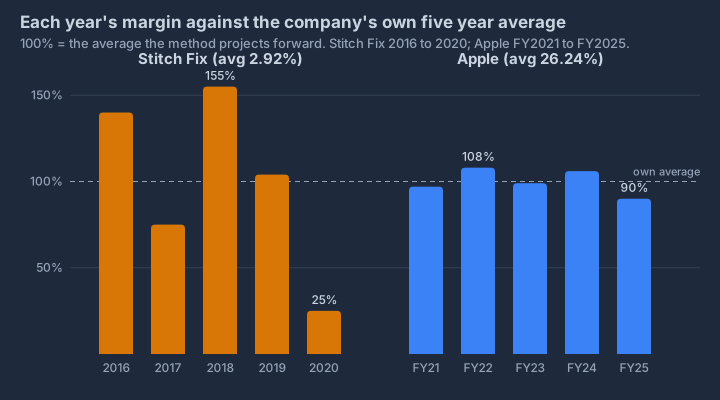
Contrast a company the method actually suits. Apple's free cash flow margins for fiscal 2021 through 2025, computed from its filed accounts, are 25.4, 28.3, 26.0, 27.8 and 23.7 percent. Five year average: 26.2 percent. The widest year is barely 1.2 times the narrowest. When a margin sits inside a band like that, the average means something, and multiplying projected revenue by it is a defensible shortcut. Even here the analyst must look before averaging: fiscal 2025's margin is the lowest of the five because operating cash flow fell by nearly $7 billion even as revenue grew, while capital expenditure rose from $9.4 billion to $12.7 billion, and a mechanical average quietly smooths both changes into the past's shape. Our reverse DCF on NVIDIA makes the same point about base years from the other direction.
Run the clean version forward and you get a projection worth arguing about. On the average margin, Apple's $416.2 billion of fiscal 2025 revenue produces first year free cash flow of roughly $112 to $118 billion across revenue growth scenarios of 3, 5 and 8 percent, reaching $147, $178 or $236 billion by year ten. Three scenarios, not one line; the spread between them is an honest confession of ignorance. What those cash flows are worth today depends on the discount rate, which is the next article's subject, and we stop deliberately at the projection boundary just as Halal Ninja's part two does.
What Stitch Fix Did Next
The series' later instalments carry the projection to its conclusion: free cash flow of $12.67 million in year zero rising to $319 million by year ten. Reality declined the assignment. Stitch Fix's revenue fell from $2.1 billion in fiscal 2021 to $1.27 billion in fiscal 2025, a 40 percent decline where the model assumed compounding growth. Free cash flow in fiscal 2025 was $8.9 million, below the model's year zero, never mind its year ten. The stock, which touched $106.41 at its January 2021 peak three weeks after the series concluded, traded at $4.20 in August 2026.
The point is not to mock a five-year-old forecast with hindsight; forecasting is hard, and Luqman 34 says why. The point is where the error came from. The margin arithmetic was fine. The revenue line did all the damage, and revenue growth is precisely the input the tutorial treats as a given, mentioning only that it is "often" projected from year-over-year growth predictions. A method note that delegates its most powerful input to an unexamined guess has taught the reader the easy 20 percent of the job and labelled it complete.
The Gharar Question: Forecasting the Ghayb
Is a forecast that can miss this badly a form of gharar? No. Gharar is a defect in contracts, unknown price, unknown subject matter, unknown delivery, and a projection is analysis, not a contract; the fuller treatment is in our DCF fiqh analysis. No fiqh objection attaches to writing down a growth scenario, and the Yusuf precedent shows planning under uncertainty done at prophetic standard. What fiqh does demand is honesty about the status of the numbers. A projection presented as knowledge, a single line drawn to year ten with no range around it, misrepresents the ghayb as data. The Islamic discipline is structural humility: several scenarios, a conservative base case, and a stated reason for every growth number you write down.
The Maysir Question: Hope Dressed as Arithmetic
Maysir is wealth staked on chance, and none of the scholars cited on this site has ruled on forecast methodology as such, so what follows is this article's own application of the principle. A projection built by extrapolating a hot company's best year is not analysis but a wager wearing analysis's clothes; the spreadsheet launders hope into apparent rigour. Stitch Fix in December 2020 was a pandemic favourite whose screen time flattered every trend line. The believer's protection is procedural: project from normalised figures, let the bear case be genuinely bearish, and let the risk and diversification sizing reflect that the future is scenarios, not a number.
Where the Sharia Layer Belongs
Before any projection, the screen. Valuation work spent on a non-compliant company is wasted diligence, and the tutorial projects Stitch Fix without a compliance check anywhere in the series. Apple, our worked example, passes the AAOIFI Standard 21 ratios as set out in our Apple analysis, and you can check any ticker's screen on the stock screener before opening a spreadsheet. The order matters: screen, then project, then value, the same sequence our company analysis guide builds through the DuPont lens. And the method's boundary is itself instructive: an asset with no cash flows cannot be projected at all, which is why tokens screened on the crypto screener answer compliance questions but leave nothing for this method to grip.
What Halal Ninja Gets Right, and What It Leaves Out
Credit first. The margin method is real, the shortcut is one practitioners use, the Stitch Fix figures are filed ones, the capex assumption is declared rather than hidden, and the prose is clear. As conventional finance teaching for beginners, part two does its job.
What it leaves out is everything that makes the method safe or Islamic. It never states the stability premise, never tests it, and applies the method to a company whose margins fail the test sixfold. It hands the reader the multiplication while waving at the revenue projection, which is where the Stitch Fix forecast actually died. It projects an unscreened company on a site whose name promises otherwise, cites no standard and no scholar, and offers a single trajectory where honest ignorance requires a range. Our version is better by coverage, not cleverness: the same shortcut, the stability test that guards it, a screened company, three scenarios, and the fiqh of planning stated with sources.
Where Scholars Differ
None of the scholars in scope has published a ruling on cash flow forecasting methodology, so the honest framing is emphasis, not verdict. Mufti Taqi Usmani's conditions in Principles of Shariah Governing Islamic Investment Funds attach weight to a company's real assets, an instinct that anchors analysis to what exists rather than what is hoped; extending that instinct to suspicion of valuations that live mostly in distant projected years is this article's own application, not his stated position. Sheikh Joe Bradford, as Shariah advisor supervising Zoya's screening logic (joebradford.net, 2020), works from AAOIFI's quantitative ratios, treating compliance as checkable arithmetic and leaving forecasting judgement to the investor. Mufti Faraz Adam's methodology at Amanah Advisors examines revenue streams individually, which pushes the analyst toward exactly the granular revenue scrutiny Halal Ninja's tutorial skips. These are differences of emphasis within a shared permissibility, and this article does not convert any of them into a ruling on projections.
Practical Guidance
Screen the company first and stop if it fails. Pull five years of filed figures yourself and compute the free cash flow margin for each year before you average anything; if the widest margin is more than about twice the narrowest, a rough rule of thumb rather than any standard's threshold, the average is noise and the method does not fit the company. Ask why the latest margin sits where it does before letting an average dilute it. Project revenue in three scenarios and write one sentence justifying each growth rate; if you cannot write the sentence, you do not have a projection, you have a hope. Extrapolate from a normalised year, not a flattering one. And carry the whole range, not the midpoint, into the valuation stage.
Conclusion
Halal Ninja's part two teaches a genuine shortcut and demonstrates, unintentionally, exactly how it fails. The margin method is only as good as the margin's stability, Stitch Fix never had a stable margin, and the revenue guess the tutorial delegates to the reader is the input that destroyed the forecast. Yusuf's fourteen year plan and Luqman's warning frame the discipline a Muslim brings to the same spreadsheet: project because diligence demands it, in ranges because humility does, from screened companies because compliance comes first, and from normalised figures because honesty is a commercial obligation before it is a virtue. The projection is the easy multiplication. The work is earning the numbers you multiply.
This analysis is educational and is not a fatwa, a forecast, or financial advice. Figures are from the filings and sources cited and change with each reporting period; verify before acting.
Frequently Asked Questions
Is projecting a company's future cash flows halal?
Yes. A projection is planning, not a contract and not a claim to know the unseen. Surah Yusuf records a seven year cultivation plan issued and executed under prophetic guidance, and no riba, gharar or maysir arises from writing down a scenario.
What is the FCF margin method Halal Ninja teaches?
Project revenue forward, compute the historical average ratio of free cash flow to revenue, and multiply. It is a legitimate shortcut that avoids forecasting every line item separately.
What is wrong with how the article applies it?
The method requires a stable margin and the article never says so. Stitch Fix's margins ranged from 0.74 to 4.53 percent, a sixfold spread, so the 2.92 percent average was an artefact, not a property of the business.
How did the Stitch Fix projection turn out?
Revenue fell about 40 percent from fiscal 2021 to fiscal 2025 instead of growing, fiscal 2025 free cash flow was $8.9 million, below even the model's year zero figure of $12.67 million, and the stock fell from a $106.41 peak to $4.20 by August 2026.
Does a badly missed forecast involve gharar?
No. Gharar is a defect in contract terms, not in analysis. A share bought at a known price is contractually certain even if the buyer's forecast proves wrong. The fiqh concern is honesty: present projections as scenarios, not knowledge.
Which companies suit the margin method?
Companies whose free cash flow margin sits in a narrow band, like Apple's 23.7 to 28.3 percent over five years. A quick spread check on five years of filed figures tells you whether the average is meaningful before you use it.
Why project in scenarios instead of one number?
Because no soul knows what it will earn tomorrow. Three justified scenarios confess the uncertainty a single trajectory hides, and the spread between them is information the valuation stage needs.
Sources
- Projecting FCF Forward - Halal Ninja (part two of the DCF series)
- Discounting FCF and Finding Present Value - Halal Ninja
- Putting It All Together - Halal Ninja (final instalment, January 7, 2021)
- How Does Zoya Screen Stocks for Shariah Compliance? (Zoya Help Center)
- Qur'an 12:47, Arabic and Saheeh International translation
- Qur'an 31:34, Arabic and Saheeh International translation
- Apple Form 10-K, fiscal 2025 (SEC EDGAR)
- Apple Reports Fourth Quarter Results (Apple Newsroom, October 2025)
- Apple Cash Flow Statement (stockanalysis.com)
- Stitch Fix Financials (stockanalysis.com)
- Stitch Fix Stock Price History (companiesmarketcap.com)
- AAOIFI Shari'ah Standards (Standard No. 21, Financial Paper)
- Mufti Taqi Usmani, Principles of Shariah Governing Islamic Investment Funds
- Sheikh Joe Bradford, joebradford.net (Zoya Shariah advisor)
- Mufti Faraz Adam, Amanah Advisors